

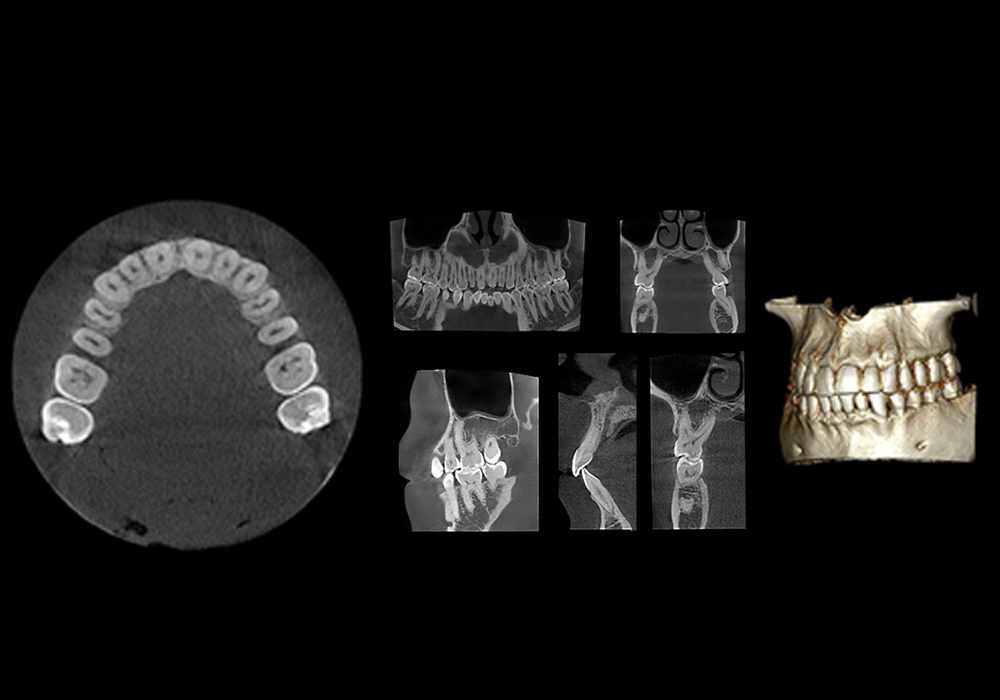
Normal dental Cone Beam Computed Tomography (CBCT)
Normal dental Cone Beam Computed Tomography (CBCT)
Warning! The maxillary and mandibular third molars are missing on this exam.
Introduction
The dental Cone Beam Computed Tomography (CBCT) exam has been widely accepted for clinical application in almost every field of dentistry.
Dental CBCT allows dental specialists (dentists, OMFS, implantologists and endodontists) to:
- Evaluate the underlying bone structure, as well as the nerve pathways and surrounding soft tissues
- Show potential dental issues such as tooth decay, bone loss, abnormal growths, facial fractures, periodontal infections, irregularities of the temporomandibular joint and problems with the tooth roots or dental pulp.
- Plan dental implants.
- Provide accurate measurements, including the shape and dimensions of the mandible.
- Identify gum issues.
- Evaluate the sinuses and nasal cavity.

Material and methods
This dental CBCT was performed by Antoine Micheau MD (Radiologist, Montpellier - France) on a male patient using a ProMax 3D Planmeca.
Unfortunately, the maxillary and mandibular third molars are missing (wisdom teeth removed when young).
Imaging planes and reconstructions were chosen according to those used the most often in daily routine: orthogonal (transverse), sagittal and frontal planes, curved MPR reconstruction with cross-sections of the teeth and panoramic (orthopantomogram) reconstructions, 3D volume rendering of osseous structures.
The anatomical structures were labeled by Antoine Micheau MD (Radiologist - Montpellier, France), based on Terminologia Anatomica 1.
They have been grouped into different themes:
- General Anatomy
- Bones
- Cranium
- Sphenoid bone
- Ethmoid bone
- Inferior nasal concha bone
- Vomer
- Maxilla
- Palatine bone
- Mandible
- Cranial sutures
- Dental nomenclature
- Structure of the teeth
- Surface and orientation of teeth
- Cusps of teeth
- Roots of teeth
- FDI World Dental Federation notation
- Universal Numbering System
- Oral cavity
- Nasal cavity
- Maxillary sinus
- Nerves
Key images


- Terminologia anatomica: international anatomical terminology By the Federative Committee on Anatomical Terminology (FCAT). Stuttgart: Georg Thieme Verlag. ISBN-10: 3-13-114361-4. ISBN-13: 978-3-13-114361-7
- Pocket Atlas of Human Anatomy: 5th edition - W. Dauber, Founded by Heinz Feneis
- Dental Radiology - Fuhrmann, A. - ISBN: 3132004219, 7831320042 - Thieme
- Anatomy for dental medicine - Baker, Eric W., Michael Schünke, Erik Schulte, and Udo Schumacher. Thieme. 2015.